Most people don't walk into a clinic asking for an IV. They walk in tired, run down, or recovering from something. The real question is rarely "should I try a drip," it's "which one, and why that one for me," and that is a clinical question deserving a clinical answer.
Quick Answer: Which IV therapy is right for me in Atlanta?
The right infusion depends on the goal you are solving for, not on what is trending. Hydration and electrolyte drips address acute fluid loss from illness, heat, or travel. A Myers' Cocktail targets broad micronutrient repletion and fatigue. NAD+ is used for cellular energy and cognitive support, while glutathione and high dose vitamin C are antioxidant focused. A qualified Atlanta clinic should ask about your symptoms, medications, kidney and heart function, and recent labs before recommending any formula, and should tell you plainly when an IV is not the answer.
Key Takeaways
- Goal drives the formula: Hydration, fatigue, antioxidant support, and cognitive complaints call for different infusions. There is no single "best" drip.
- Absorption is the real advantage: Intravenous delivery bypasses the gut, which matters most for people with malabsorption, IBD, post surgical anatomy, or nausea.
- Screening is non negotiable: Kidney function, cardiac history, G6PD status, and medication interactions should be reviewed before your first infusion, not after.
- An IV is not a diagnosis: Persistent fatigue deserves a workup covering thyroid, iron, B12, sleep, and hormones before it is treated with repeat drips.
- Frequency should be intentional: Most wellness protocols run weekly to monthly for a defined window, then get reassessed against symptoms and labs.
- Credentials matter locally: Ask who writes the order, who places the line, and what happens if you react. Those three answers separate clinics quickly.
1. What Atlanta IV Therapy Actually Is and What It Isn't
Intravenous nutrient therapy is the delivery of sterile fluids, vitamins, minerals, and antioxidants directly into a peripheral vein. Because the infusion enters the bloodstream without passing through the stomach and small intestine, it sidesteps the two biggest variables in oral supplementation: how much of a nutrient your gut can absorb, and how much your liver clears before it reaches circulation. That is the honest mechanical advantage, and it is a real one.
What IV therapy is not is a treatment for a disease you have not been evaluated for. I see patients in Decatur and across metro Atlanta who have been receiving infusions monthly for a year for "low energy" without anyone checking a ferritin, a TSH, or a sleep history. Sometimes the drip helps them feel better for a few days. That is not the same as solving the problem. The most useful way to think about IV therapy in Atlanta is as a delivery method that can support a plan, not as the plan itself.
The absorption question, honestly stated
Oral supplementation works well for most healthy adults. Where it falls short is in specific, identifiable situations: inflammatory bowel disease, celiac disease, prior bariatric surgery, chronic proton pump inhibitor use, active vomiting or diarrhea, and certain genetic variants affecting nutrient conversion. In those cases, the difference between what you swallow and what reaches your cells can be substantial. That is the population for whom infusion therapy makes the clearest physiological sense.
What the evidence supports and where it is thin
Hydration therapy for dehydration is well established and unremarkable. It is standard medicine. Micronutrient infusions for deficiency states are similarly well grounded when a deficiency has been documented. Where the literature is thinner is in the wellness applications: general fatigue, immune "boosting," hangover recovery, and athletic performance. Some patients report meaningful subjective improvement. The controlled data is limited, and any clinician who tells you otherwise is overselling. I would rather you go in with accurate expectations and be pleasantly surprised.
2. Start With the Goal, Not the Drip
The single most common mistake I see is patients choosing a formula from a menu before anyone has clarified what they are trying to change. Reverse the order. Name the problem in one sentence, then work backward to the intervention.
Four goals that lead to different answers
"I'm dehydrated right now." Acute fluid loss from a stomach bug, a hot Atlanta August, food poisoning, or a long haul flight responds to volume and electrolytes. This is the most straightforward use case and the one with the clearest, fastest subjective response.
"I'm exhausted and nothing is obviously wrong." This warrants a workup first. Thyroid function, complete blood count, ferritin, B12, vitamin D, and a careful sleep and stress history should come before a standing infusion schedule. If a deficiency turns up, repletion by either route becomes targeted rather than speculative.
"My gut doesn't absorb well." Documented malabsorption is the cleanest indication for intravenous micronutrients. Here the infusion is not a shortcut, it is the appropriate route.
"I want antioxidant or longevity support." This is where glutathione, high dose vitamin C, and NAD+ live. It is also where expectations need the most careful calibration, because outcomes are subjective and the research is still developing.
3. Comparing the Most Common IV Formulas
The table below covers the formulas most Atlanta clinics offer. Session times are typical ranges, and individual protocols vary based on dose and tolerance.
| Formula | Primary Components | Commonly Used For | Typical Session Length | Key Screening Consideration |
|---|---|---|---|---|
| Hydration and electrolyte | Saline or lactated Ringer's, electrolytes | Acute dehydration, illness, heat, travel | 30 to 45 min | Cardiac and kidney status, fluid volume tolerance |
| Myers' Cocktail | Magnesium, calcium, B complex, B12, vitamin C | Fatigue, migraine, general micronutrient repletion | 45 to 60 min | Magnesium push rate, kidney function |
| NAD+ | Nicotinamide adenine dinucleotide | Cellular energy, cognitive clarity, recovery support | 2 to 4 hours | Infusion rate. Pushed too fast it causes chest tightness and nausea |
| Glutathione | Reduced glutathione | Antioxidant and detoxification support, skin | 20 to 30 min | Often given after another infusion, sulfur sensitivity |
| High dose vitamin C | Ascorbic acid | Immune and antioxidant support, collagen synthesis | 60 to 90 min | G6PD deficiency must be ruled out before high doses |
| Methylene blue | Methylene blue | Mitochondrial and cognitive support | 30 to 60 min | Serious interaction with SSRIs, SNRIs, and other serotonergic drugs |
Reading the table like a clinician
Two rows deserve emphasis. High dose vitamin C requires G6PD screening, because in deficient individuals it can precipitate hemolysis. This is a blood test, it is inexpensive, and skipping it is not acceptable practice. Methylene blue functions as a monoamine oxidase inhibitor at clinical doses, which makes it genuinely dangerous alongside common antidepressants. If a clinic offers either without asking about your medications and running the appropriate screening, that tells you something important about the clinic.
On the Myers' Cocktail specifically
The Myers' Cocktail remains the most requested formula for a reason. It is a sensible, broad micronutrient blend with decades of clinical use behind it, and the magnesium component is often what patients notice most: a settling, muscle relaxing effect that arrives during the infusion itself. It is a reasonable starting point for someone with fatigue or tension headaches who has already had baseline labs reviewed.
On NAD+
NAD+ infusions are the longest and, for most people, the least comfortable if rushed. Given slowly, they are tolerable. Given quickly, patients describe chest pressure, abdominal cramping, and a flushed, anxious feeling that resolves the moment the rate is reduced. If you are considering NAD+, ask specifically how long the clinic budgets for the infusion. A clinic quoting 45 minutes is planning to run it too fast.
4. Who Tends to Benefit and Who Should Wait
Reasonable candidates
Adults with documented nutrient deficiencies, malabsorptive conditions, or acute dehydration are the clearest fits. Beyond that, patients recovering from viral illness, those with demanding travel schedules, athletes in heavy training blocks, and people managing chronic fatigue as part of a broader treatment plan often find infusions a useful adjunct.
Situations that call for caution
Certain conditions require careful evaluation before any infusion:
- Congestive heart failure or significant cardiac disease. Fluid volume is not neutral for these patients.
- Chronic kidney disease. Impaired clearance changes the risk profile of nearly every additive.
- G6PD deficiency. A hard contraindication to high dose vitamin C.
- Active use of SSRIs, SNRIs, MAOIs, or triptans. Relevant to methylene blue in particular.
- Pregnancy or breastfeeding. Requires individualized review.
- A history of severe reactions to IV medications or preservatives.
None of these are automatic disqualifications, but each changes the calculation. That is precisely why an infusion should be ordered by a physician who has your history in front of them.
5. Safety, Screening, and What a Good Clinic Does Differently
Atlanta has a wide range of providers offering infusions, from physician led integrative practices to mobile services and retail lounges. The clinical standards vary more than most patients realize. Here is how to tell them apart.
Five questions worth asking before you book
Compounding and sourcing
Ask where the additives come from. Reputable clinics source from licensed compounding pharmacies that meet USP 797 sterile compounding standards. This is not a detail patients typically think to raise, and it is one of the more meaningful differentiators in safety.
6. What a Session Actually Looks Like
For a first visit, plan on more time than the infusion itself requires.
Before
You will review your health history, current medications and supplements, allergies, and goals. Depending on the formula, a provider may order labs or check a point of care panel. Blood pressure and heart rate are recorded. Eat something beforehand and drink water. A well hydrated vein is an easier vein, which makes the whole experience better.
During
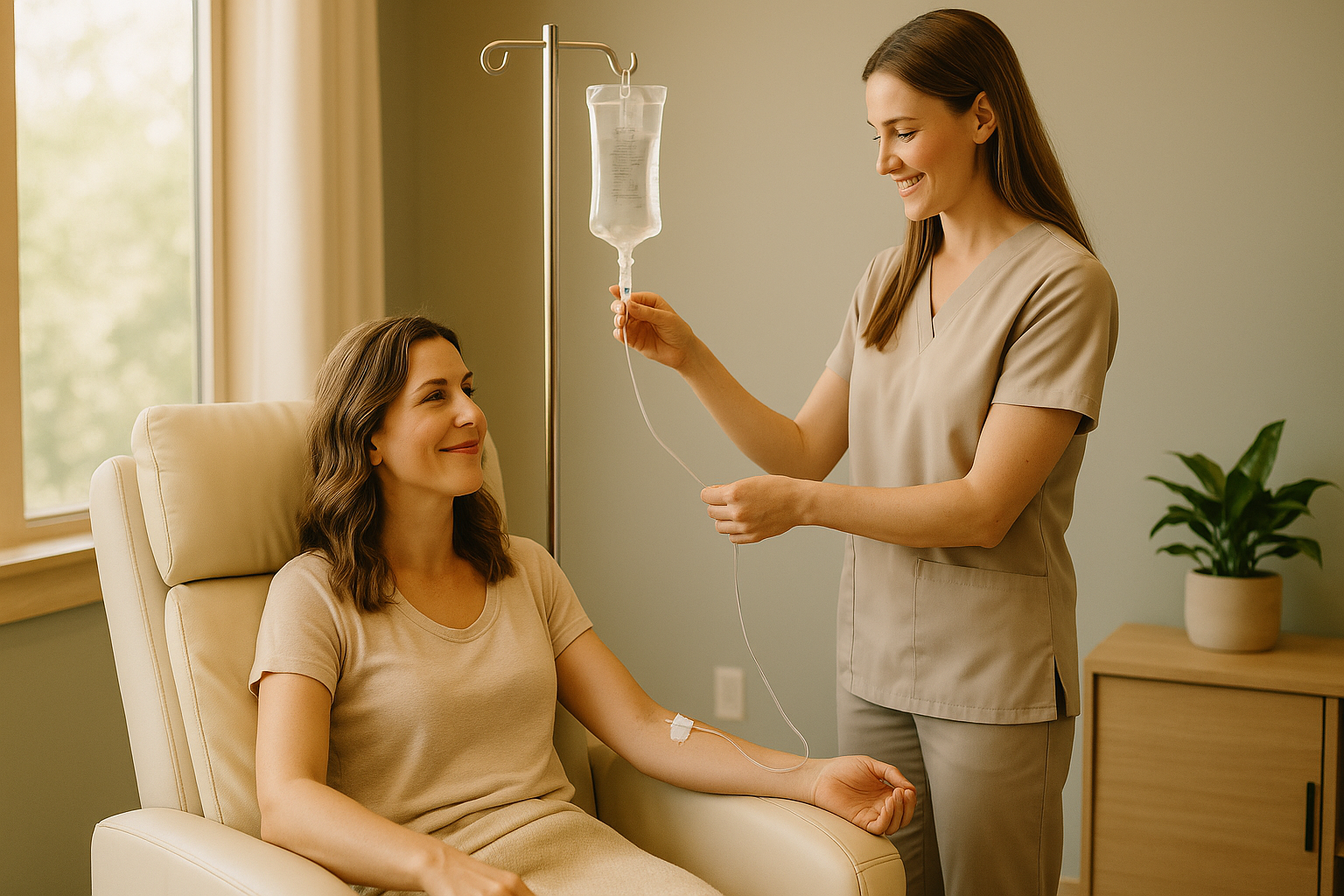
A small catheter is placed, usually in the forearm or the back of the hand. There is a brief pinch at insertion, and after that most people are comfortable enough to read, work, or nap. Depending on the formula you may notice a warm flush, a metallic or vitamin taste, or a cooling sensation along the arm. All are common and benign. Staff should check on you at regular intervals and adjust the drip rate if anything feels off.
After
The catheter comes out, pressure is held, and you are free to go. Some patients feel noticeably better within hours, others describe a gradual lift over a day or two, and a minority feel nothing different. Mild bruising at the site is common. Fever, spreading redness, or significant swelling is not, so call your provider if any of those appear.
7. Building IV Therapy Into a Larger Plan
The patients who get the most from infusion therapy are almost never the ones treating it as a standalone fix. They are the ones using it to support a plan that already has structure.
Test, then treat
Before committing to a series, I want to know what we are correcting. Functional and genetic testing can identify specific deficiencies, absorption issues, and metabolic patterns that make the difference between a targeted protocol and an expensive guess. If your ferritin is 8, that is the finding, and it changes what we do next entirely.
Reassess on a schedule
Set a defined window, commonly four to eight sessions, with a scheduled reassessment at the end. Compare symptoms against baseline, repeat relevant labs, and decide together whether to continue, taper, or stop. Open ended infusion schedules without checkpoints serve the clinic more than the patient.
Address the foundations underneath
No infusion outperforms adequate sleep, sufficient protein, resistance training, and managed stress. If those are unaddressed, a drip is filling a bucket with a hole in it. I would rather spend your first visit on the hole.
Frequently Asked Questions
If you are weighing your options for Atlanta IV therapy, the most useful next step is a conversation rather than a menu. Our team can review your history, look at what your labs actually show, and tell you honestly whether an infusion fits. Explore our IV therapy services or book a free consultation with our care team in Decatur.